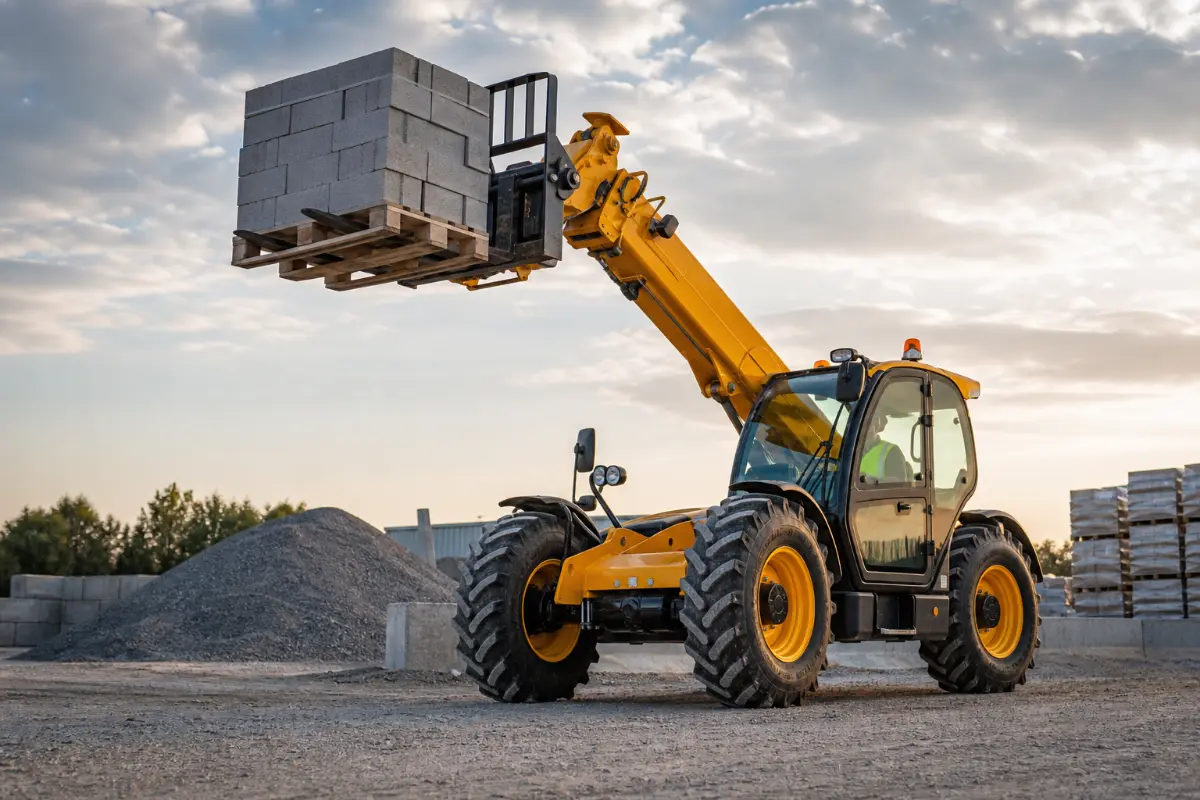
Buying a telehandler is not like buying a pickup truck with forks. It is a decision about reach, stability, hydraulics, site conditions and risk. A telehandler can unload pallets, place roof trusses, feed a masonry crew, carry pipe across rutted ground or lift a work platform when approved by the manufacturer. But the wrong machine can be underpowered, overmatched or dangerously tempting to misuse. The smartest buyers begin with the work, not the paint color, brand loyalty or a salesman’s most confident sentence.
Start with the load, not the brochure
The headline number on a telehandler, usually its maximum rated capacity, is only the beginning. A machine advertised as a 10,000-pound telehandler cannot lift 10,000 pounds at every boom angle and extension. Capacity falls as the load moves forward and upward because leverage works against the chassis. That is why the load chart in the cab matters more than the decal on the boom.
Before shopping, write down the heaviest loads you expect to handle, the dimensions of those loads and where they must be placed. A pallet of block, a bundle of lumber and a suspended truss do not behave the same way. If your worst lift is 6,000 pounds placed 30 feet high and 15 feet forward, shop for that task with margin. Buying barely enough machine is how contractors end up improvising, and improvisation is not a safety system.
"The right telehandler is not the biggest one; it is the one whose load chart matches your worst day, not your best day."
Lift height and forward reach are separate questions
Lift height gets attention because it is easy to understand. Compact telehandlers may lift around 13 to 20 feet, common construction models often reach into the 40- to 60-foot range, and specialized high-reach units can go higher. But forward reach is just as important. On a crowded job site, the operator may need to place material over a foundation wall, across a trench or onto the far side of scaffolding.
Ask dealers for load charts for the exact model and attachment you plan to use. Compare the capacity at the real height and real reach, not just maximum figures. A few feet of extra reach can be the difference between a smooth lift and a machine that must be repositioned repeatedly on unstable ground.
Choose the chassis for the ground you actually have
Telehandlers are popular because they work where warehouse forklifts do not. Four-wheel drive, large tires and multiple steering modes give them a rough-terrain advantage. Still, ground conditions vary widely. A residential builder moving material over lawns has different needs from a steel erector working on compacted stone or a farm handling bales in mud.
Tires deserve close attention. Pneumatic tires provide traction and cushioning but can puncture. Foam-filled tires reduce flats and downtime, though they add weight and can make the ride harsher. Solid tires may suit certain yards but are less forgiving on rough sites. Also look at ground clearance, turning radius and steering modes such as two-wheel, four-wheel and crab steering. A telehandler that cannot maneuver in your site’s tightest corner is a productivity problem from day one.
Hydraulics decide what the machine can become
Forks may be the standard attachment, but telehandlers earn their keep through versatility. Buckets, truss booms, lifting jibs, sweepers, grapple buckets and work platforms can all expand the machine’s role when properly rated and approved. That versatility depends on hydraulic flow, auxiliary lines, coupler type and control quality.
If you expect to run hydraulic attachments, ask about gallons per minute, pressure, proportional controls and whether the machine has the right auxiliary plumbing to the boom head. A low-flow machine may handle forks beautifully and disappoint with a grapple or sweeper. Also remember that attachments change capacity. A jib or bucket adds weight and moves the load center, so the operator must use the correct chart for that attachment.
New, used or rental-return?
New machines offer warranty coverage, current emissions systems and the chance to specify exactly what you need. In the United States, most new diesel construction equipment in this class is built to meet EPA Tier 4 Final emissions rules; in Europe, Stage V standards apply. These systems can reduce particulate and nitrogen oxide emissions, but they also make maintenance discipline more important. Diesel exhaust fluid, regeneration procedures and clean fuel practices are now part of ownership.
Used telehandlers can be excellent buys, especially from fleets with maintenance records. Inspect boom wear pads, pins, bushings, fork carriage condition, hydraulic cylinders, hoses, steering components, brakes and frame leveling systems. Look for oil leaks, cracked welds, damaged cab glass and sloppy boom movement. Hours matter, but care matters more. A 3,000-hour machine with records may be a better purchase than a 1,500-hour machine that lived a hard, undocumented life.
Do not ignore the cab
Operators spend long days in these machines, and fatigue has a cost. Visibility, seat quality, control layout, heating, air conditioning and camera systems affect productivity and safety. A clear view to the forks is essential, but so is awareness of people and vehicles around the machine. Modern telehandlers may offer load management displays, rearview cameras, telematics and interlocks. These tools do not replace training, but they can reduce blind spots in both the literal and managerial sense.
Safety is a buying criterion
A telehandler is often classified and regulated as a rough-terrain forklift when used with forks, and operators must be trained for the equipment and conditions. In the United States, OSHA requires powered industrial truck operators to be trained and evaluated. Work platforms, suspended loads and personnel lifting add further rules and manufacturer requirements. If your business frequently performs these tasks, buy a machine designed and documented for them rather than relying on job-site folklore.
Look for a readable load chart, functional seat belt, backup alarm, lights, mirrors, stable outriggers if needed, frame leveling and a cab structure in sound condition. Safety equipment that is missing or disabled is not a small defect. It is evidence of how the machine was treated.
Calculate ownership, not just purchase price
The invoice is only one line in the real cost. Fuel, DEF, filters, hydraulic oil, tires, attachments, transport, insurance, financing, inspections and downtime all belong in the calculation. So does resale value. Major brands with strong dealer networks often bring higher used prices because parts, service and buyer confidence are easier to find.
Ask the dealer about parts availability, mobile service response time, warranty exclusions and telematics fees. A cheaper machine parked for two weeks during peak season is not cheap. For contractors with seasonal spikes, renting a larger telehandler for occasional high-reach work and owning a smaller daily machine can be the more rational strategy.
The bottom line
A good telehandler buying guide ends with restraint. Do not buy the tallest boom because it looks impressive. Do not buy the cheapest used unit because it starts and moves. Buy the machine whose load chart, tires, hydraulics, attachments, cab, dealer support and safety documentation fit the work you truly do. The best telehandler feels almost boring in service: stable, capable, maintained and rarely the subject of a panicked phone call.